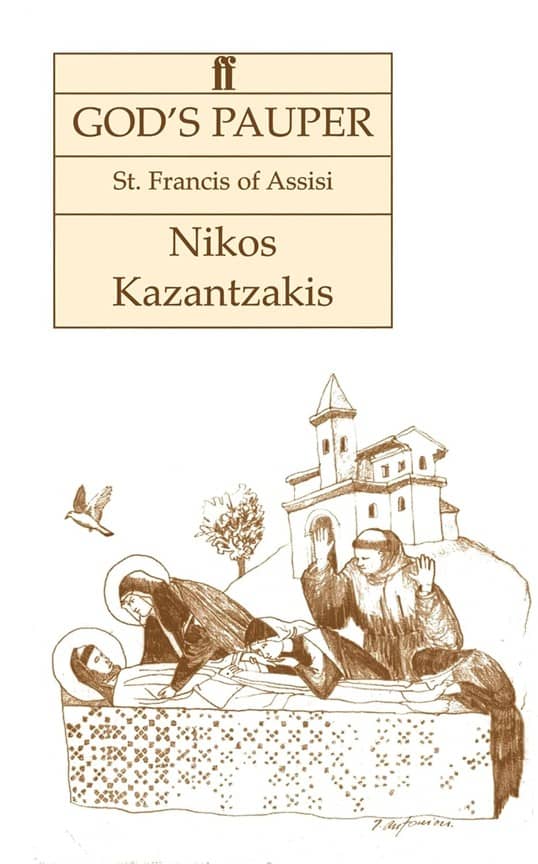
GOD’S PAUPER: ST. FRANCIS
by Nikos Kazantzakis
Reviewed by Beverly Mantyh
“If I have omitted many of Francis’ sayings and deeds and if I have altered others, and added still others which did not take place but which might have taken place, I have done so not out of ignorance or impudence or irreverence, but from a need to match the Saint’s life with his myth, bringing that life as fully into accord with its essence as possible.”
–Nikos Kazantzakis, 1953
Kazantzakis takes a modernist look at the medieval hero, St. Francis of Assisi. Educated by French monks on the Greek island of Naxos, Kazantzakis was publishing essays, novels and plays by the time he earned his law degree in Athens in 1906. He continued his studies in France, writing his dissertation on Friedrich Nietzsche, the German philosopher who pronounced God “dead. “
Kazantzakis held that the term “God” refers to whatever the most energetic and heroic people value and create. His philosophy became well known through his novels, Zorba the Greek and The Last Temptation of Christ. He was a known collaborator with the communist government in the Soviet Union, Kazantzakis became intrigued with St. Francis while recuperating from illness in Assisi in 1924.
Kazantzakis narrates Francis’ story through the eyes of Brother Leo, providing an intimate view of Francis’ life. Francis calls Leo, “the Lion of God.” He enters Francis’ life just before he decides to follow God in a radical way. Francis is still living at home, but struggling with the humiliation of illness and his failed military mission.
Originally hoping to beg food and perhaps shelter, Brother Leo unwittingly nudges Francis to follow his conscience and abandon himself to the love of Christ. In the book, Francis’ life unfolds through the filter of Brother Leo’s descriptions.
Brother Leo struggles to understand Francis’ self-denial. He sometimes appears to believe more in Francis than in a God who is personal to himself, as Kazantazakis tells it. Brother Leo remains faithful to the ideals of Love, Poverty and Chastity out of devotion to Francis, but questions the necessity of the hard sacrifices Francis requires of himself and the Friars Minor. Through the original friars and Brother Leo, Kazantazakis reflects upon the struggle to overcome selfishness and to accept suffering.
Kazantazakis assumes that his manipulation of the facts justifies “capturing the essence” of St. Francis. He does not succeed in capturing Francis’ whole essence. He focuses on self-denial and suffering, while missing the love and the gratitude to Christ that inspired Francis to abandon all. Where is the beloved Francis whose joy inspires others to follow the Franciscan way?
On the other hand, Kazantazakis does an incredible job at capturing the universal struggle with temptation, suffering and doubt. Although this book has its problems, Kazantzakis’ St. Francis is a worthwhile read for its deep inquiry into the problem of sin versus the zeal of saintliness.
Discussion Questions:
- Father Silvester brought a small bundle with him when he came to join Francis. Francis tells him the story of an ascetic whose sole possession, a richly decorated pitcher, prevented him from seeing God. After he smashed it, he saw God for the first time. What is in your bundle? What attachments are holding you back from seeing God?
- Brother Leo was a faithful follower and a consolation to Francis. Even though he struggled with the severity of Francis’ asceticism, he trusted that he was doing God’s will. Are you a Brother Leo or a Francis? Is Christ asking you to nurture and encourage or does He ask you to lead? Do you play different roles in different relationships?
- Like Francis, Sister Clare left her comfortable position in life to wed herself to Christ through Love, Poverty and Chastity. It was her order who remained most true to Francis’ rule. Francis implored the sisters to join with the Blessed Virgin to pray especially for women. The Poor Clares do intercede for the world. Have you been called to intercessory prayer?