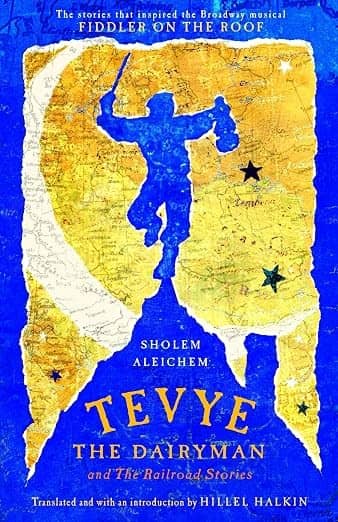
The majority of Americans may know little about the Jewish faith. Only about 2% of Americans are Jewish, although in sheer numbers, America is home to more Jewish people than any other nation except Israel. By contrast, the majority of Americans probably have heard of Fiddler on the Roof. The musical premiered on Broadway in 1964, and the film adaptation came out in 1971. Still frequently staged by student and community theatre troupes, many of the songs are familiar to young people: “Tradition,” “Sunrise, Sunset” and “If I Were a Rich Man.” Where did the story of the distinctive character of Tevye come from? A rabbi from Ukraine, Sholeim Rabinovitz, wrote the stories in Yiddish under a pseudonym, Sholem Aleichem. He had personal experience of the pogroms in Russia in the 35 years before World War I. He began writing in 1894, and completed his stories about Tevye in 1914, two years before his death in America. He wrote the stories as humor. Yes, you read that right, humor. “It is a matter of record that the Jews of his time who read his work, or heard him read it himself at the many public performances that he gave, not only laughed until their ribs ached at his unsparing portrayals of their perversity, ingenuity, anxiety, tenacity, mendacity, humanity, unplumbable pain, and invincible hopefulness, they emerged feeling immeasurably better about themselves and their fate as Jews.”
— Hillel Halkin, in the introduction to Tevye the Dairyman.
In a world turned upside down, where fully one-third of the Jews in Russia emigrated to America, Tevye the Dairyman was a resilient, tragic, and faithful hero. Aleichem’s readers could relate to Tevye, and his over-the-top personality included an ongoing monologue that was both humble and insightful. Each of his daughters and their marriages symbolize the many challenges facing the Jewish people in Aleichem’s day. Through it all, the warm love for his daughters shines through the challenges, pointing to the great love of God in that ancient covenant which undergirded their strength. Tzaytl, the oldest marries a poor tailor for love, and ends up widowed with many children, not unlike Tevye who was a Jew in Russia with limited means to provide for a family. Hodl marries Pertchik, who was seduced by revolutionary fervor, as many Jews were in this period. Chava leaves the Jewish faith to marry a Christian, and her family treats her as dead. Shprintze falls in love with a wealthy Jewish man from the city whose mother opposes their union. In the aftermath, she commits suicide. The youngest, Bielke, marries a rich, assimilationist Jew whose opulent palace leaves her miserable. Eventually, he loses his fortune and they move to America, working menial jobs. Aleichem’s genius was to present the character of Tevye as Job, suffering again and again due to circumstances far beyond his control. All in all, it is worth reading the original subtext of the Fiddler on the Roof phenomenon. Rather than a morality tale about embracing the modern world, it is an uplifting assessment that love endures, even and especially in the hard times that Jewish families faced. Discussion Questions: 1. Tevye frequently discusses his frustrations with God. How and when do you share your frustrations with God? If not, why not? 2. Tevye often dreams of having a rich daughter to care for him in his old age. Have you ever had magical dreams of financial windfalls? 3. Some scholars point to the generational traumas of the pogroms, Holocaust and other oppressions in their collective memory as an ongoing source of mental health struggles. Do you know of traumas within your own family? How do we create pathways of healing in families?
|
Book Review: Tevye The Milkman’s Back Story



Related Newsletters
Edith and Erna: The Little Scholars
Summary of Ch 2 of Life in a Jewish Family by Edith Stein

Meet Susanne Batzdorff, Edith’s Stein niece
A compilation of excerpts from interviews with Susanne Batzdorff, niece of Edith Stein (St. Teresa Benedicta of the Cross) in...(read more)

Shema Israel – Deuteronomy 6:4-9
A Bible Study of Deuteronomy 6:4-9 from My Secret is Mine newsletter, explaining the Jewish prayer the Shema Israel and...(read more)