|
“Secretum meum mihi?”Published on May 4, 2026
Dear friends, We are on a journey of exploration in May. After three years of posts, the team at My Secret is Mine is exploring some new opportunities, and spending the next month in prayer over our content and apostolate. As a subscriber, we invite you to share your feedback. As we review and pray over our work, we are reprinting some of our best posts. We hope you enjoy one of our first Bible studies. When Edith Stein told her best friend, Hedwig Conrad-Martius, she was becoming a Catholic, her friend was shocked. In the face of her exclamations, Edith silently wrote on a piece of paper: secretum meum mihi. Here’s the Bible verse she was referring to 
Isaiah 24:15-18: “Therefore glorify ye the Lord in instruction: the name of the Lord God of Israel in the islands of the sea. From the ends of the earth we have heard praises, the glory of the just one. And I said: My secret to myself, my secret to myself, woe is me: the prevaricators have prevaricated, and with the prevarication of transgressors they have prevaricated. Fear, and the pit, and the snare are upon thee, O thou inhabitant of the earth. And it shall come to pass, that he that shall flee from the noise of the fear, shall fall into the pit: and he that shall rid himself out of the pit, shall be taken in the snare: for the flood-gates from on high are opened, and the foundations of the earth shall be shaken.“ (From the Douay-Rheims translation of the Latin Vulgate) Edith Stein was a young post-grad student, the rising star of her circle in Gottingen under famed philosopher Edmund Husserl. When she embraced baptism in 1922, her best friend Hedwig Conrad-Martius demanded to know why. Stein never responded, but wrote, “secretum meum mihi,” on a nearby page of paper. (Latin for “my secret is mine, or my secret is unto me.” Indeed, her conversion was devastating to her Jewish family. And although she was aware of a vocation to Carmel early on, at the advice of her confessor, she chose not to follow for over a decade. Edith Stein is not the only one to have quoted this tidbit “Secretum Meum Mihi” in relation to keeping the inner details of one’s faith private. The famous English convert John Henry Newman quotes it in his conversion account Apologia Pro Vita Sua, and St. Philip Neri also quotes it in his exhortations to his followers. And Bernard of Clairvaux, the great Cistercian, quotes it in relation to a commentary on the Song of Songs. All of them concurred: a relationship with Jesus Christ was a mystery one could never fully explain to anyone. Context: This section of the book of Isaiah is known as his Apocalypse. Apocalyptic literature often focused on a future “day of the Lord”, when the “just one” would reward the good and punish the bad. In this particular passage, the human praise of the Just One is side by side with His expected wrath to sinners. Against the bloody backdrop of current Middle East politics, we might be excused for taking the whole section far too grimly to heart. Will the Lord deliver us? Do my secret longings for God’s mercy open me up to His justice? Yet, being set free implies the truth that we are imprisoned…spiritually, emotionally, and otherwise. Translation Notes: Almost certainly, the Bible in your home does not have “my secret is unto me” in it at Isaiah 24:16. Because there are no vowels in Hebrew, a variety of translations are possible, and the context is thus very important. The original Hebrew word, r-z-h, transliterated “ryzyk”, translates roughly to “thinness, or leanness”. Within the context of the passage, the Latin translation connotes a certainty of weakness as one faces the coming judgment. Subsequent English translations of the original Hebrew use “leanness” – “I waste away,” or “I pine away”. (Or – I’m skinny! Woe is me!) Vocabulary The Just One: a reference to the coming of the Messiah in Jewish apocalyptic literature, who would judge and punish the unrighteous in the last days Prevaricators: Those who deviate from the truth The Pit: Hell, or more technically, Sheol, a concept of the afterlife in which one does not merit God’s friendship. Discussion Questions: 1. Did you get tripped up by the “prevaricators, prevaricating?” It is an alien concept in our culture to call out people who deviate from the truth. Why do you think that is? Is it wise, or not wise, to address someone who “prevaricates?” 2. Edith Stein was ultimately killed at Auschwitz for being Jewish. Religious persecution remains a serious problem today. What should Christians in “safe” countries do to support their suffering and persecuted brothers and sisters in oppressed lands? 3. My secret is mine. Sometimes, I wonder if others even know I am a Christian. As some wag once put it, if the state began to persecute Christians, would they be able to dig up enough dirt to condemn you for the crime? Should we as Catholics proselytize more by words or by example? Why? What does it mean to say, “my secret is mine?”
|
“Secretum meum mihi?”


Related Newsletters
Edith and Erna: The Little Scholars
Summary of Ch 2 of Life in a Jewish Family by Edith Stein

Book Review: Tevye The Milkman’s Back Story
A book review in My Secret is Mine newsletter for Tevye the Dairyman by Sholem Aleichem, the backstory to Fiddler...(read more)

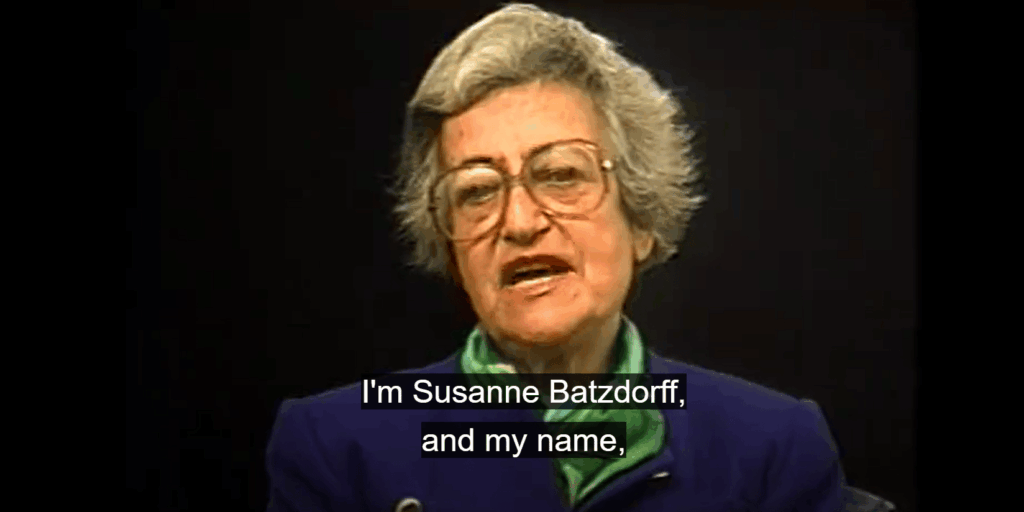
Meet Susanne Batzdorff, Edith’s Stein niece
A compilation of excerpts from interviews with Susanne Batzdorff, niece of Edith Stein (St. Teresa Benedicta of the Cross) in...(read more)