|
Back to the GardenPublished on July 14, 2026
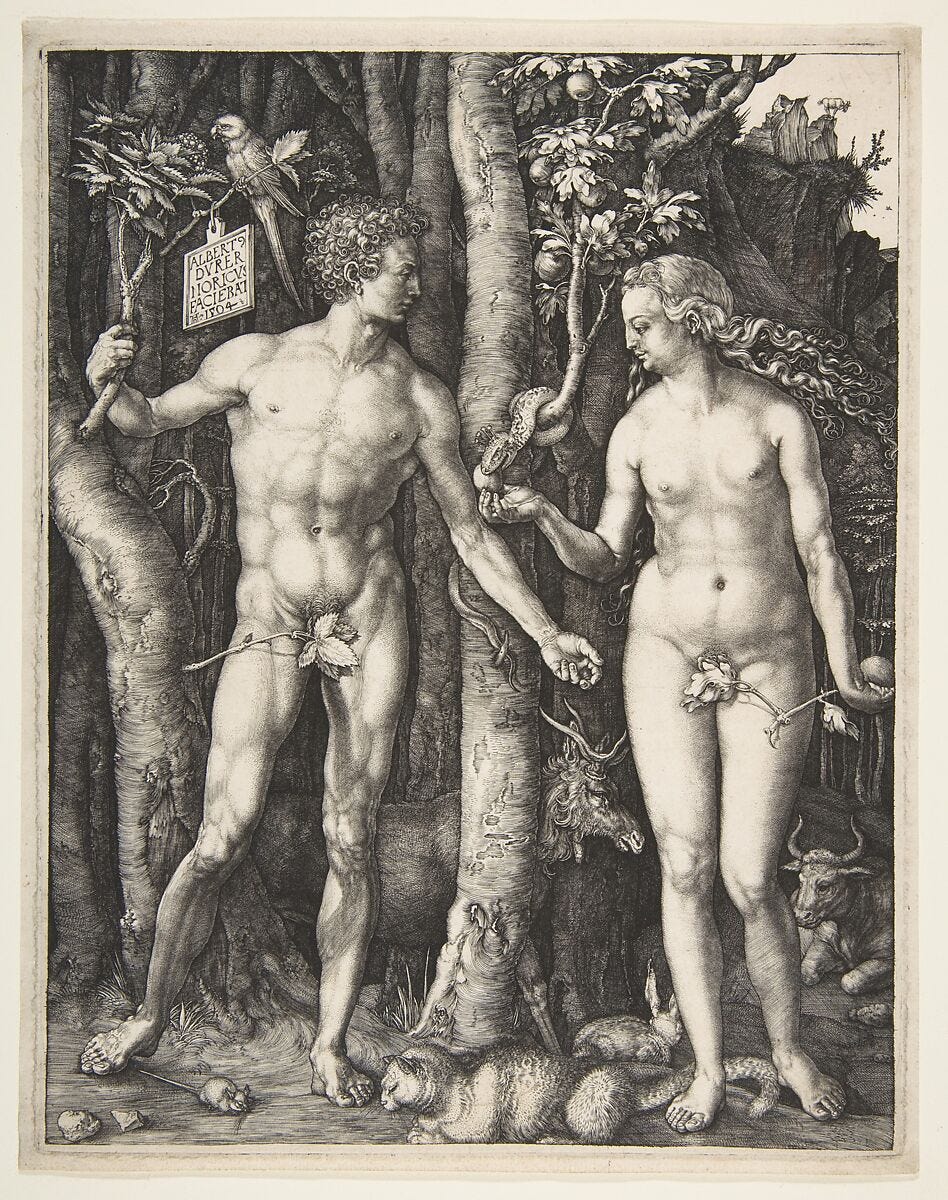
Genesis 2:15-25 And the Lord God took man, and put him into the paradise for pleasure, to dress it, and keep it. And he commanded him, saying: Of every tree of paradise thou shalt eat: But of the tree of knowledge of good and evil, thou shalt not eat. for in what day soever thou shalt eat of it, thou shalt die the death. And the Lord God said: It is not good for man to be alone: let us make him a help like unto himself. And the Lord God having formed out of the ground all the beasts of the earth, and all the fowls of the air, brought them to Adam to see what he would call them: for whatsoever Adam called any living creature the same is its name. And Adam called all the beasts by their names, and all the fowls of the air, and all the cattle of the field: but for Adam there was not found a helper like himself. Then the Lord God cast a deep sleep upon Adam: and when he was fast asleep, he took one of his ribs, and filled up flesh for it. And the Lord God built the rib which he took from Adam into a woman: and brought her to Adam. And Adam said: This now is bone of my bones, and flesh of my flesh; she shall be called woman, because she was taken out of man. Wherefore a man shall leave father and mother, and shall cleave to his wife: and they shall be two in one flesh. And they were both naked: to wit, Adam and his wife: and were not ashamed. Context: There are two accounts of the creation of man in the book of Genesis. The first, in Genesis 1:1 – 2:4, emphasizes the essential unity of man and woman before the Lord, and their twofold mandate to exercise dominion over the natural world, and to be fruitful and multiply. The second account (Genesis 2:4-25) emphasizes the incompleteness of man without woman. This account of the bliss of Eden is untainted by power issues, which arose after the fall. The essential harmony of their relationship is depicted by their lack of shame. Translation: Scholars believe that the first creation account is a compilation done by priests of the Temple, possibly even prior to the first Babylonian exile (about 500 B.C.) The second is more human centered, and yet retains evidence that it began as a story told and retold by Mesopotamians over the centuries. (Its similarities with the Babylonian creation epic, Enuma Elish, are striking.) Vocabulary: Eden: derived from a Sumerian word meaning “fertile plain,” Eden connotes a similar Hebrew word meaning “delight”; the Greek word in the Septuagint means, “paradise.” “helper like himself:” eser k’negdo: (helpmate) Eser is a derivative of help, which shares a root that means strength (oz). The root of k’negdo means “opposite” or “in front of.” It’s usually translated “corresponding to him.” Clearly, it does not imply subservience, but mutual strength. “one flesh”: modern translations usually say “one body”; classical Hebrew has no specific word for “body.” The sacred writer stresses the fact that conjugal union is willed by God. Meditation: Adam recognized Eve. He was probably getting tired of naming creatures. It’s lonely at the top of the food chain! Although he apparently slept through the rib extraction, he knew enough to call her his own. God created humans in the image and likeness of God, which included two sexes. His goodness overflows. So, both men and women together truly embody the full goodness of God. Is it too much of a stretch to posit that woman ensures that man appreciates the world we share? A baby’s first learned response is the smile, when Junior recognizes the embrace of the loving caregiver and crinkles his little eyes in response. The baby “recognizes” the love, and responds. There is an echo in this learning of our essential goodness. The first account of Genesis emphasizes one fact that the second account forgets to mention. God was very pleased, and even called us, “good.” Together. In all relationships, men and women find that they bring differing and complementary strengths to the table. Obedient to their calling, women have a unique gift for enjoying the fruits of the earth and celebrating God’s gifts. Likewise, men recognize in women the key to appreciating all of creation, before the Lord. Discussion Questions: 1. Are there differences between men and women in what evokes a smile? Why is that? 2. There seems to be an inner compass that helps us recognize a friend. It’s easy to love those who are like us. The intimacy of Adam and Eve in the garden was related to that recognition of shared humanity and the absence of sin. How can we create little pockets of Eden in today’s world? 3. The prevalence of lust in modern society has changed interactions between men and women in many ways. How does the experience of authentic love heal those effects of sin? (with the original helpmates…)
|
Back to the Garden


Related Newsletters
Read: The Town Beyond the Wall, by Elie Wiesel
The Town Beyond the Wall, by Elie Wiesel Reviewed by Margaret McGuire For the next year, My Secret is Mine...(read more)

Meet Simone Rizkallah
AN interview on the My Secret is Mine Podcast with SImone Rizkallah, founding member of Catholics Against Anti-semitism

Join us for “Under Mary’s Mantle: The Feminine Soul”
Information on a six week study class for Catholic Women; Under Mary's Mantle: The Feminine Soul, taught by Genevieve Kineke,...(read more)